04
Oct 09

NYC Tea Meetup #2

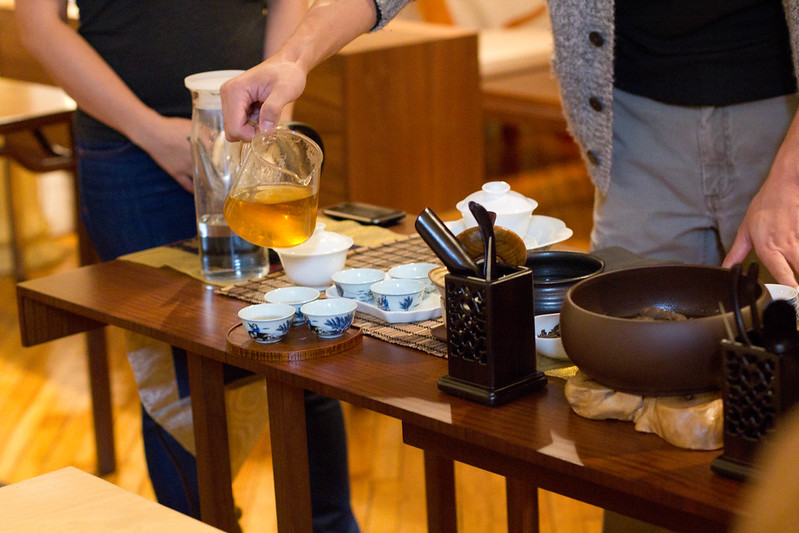
The sec­ond meetup was hosted by Tim in his spa­cious studio.

Tak­ing a page from Tai­wan tea eval­u­a­tion, we used a com­pe­ti­tion tast­ing cup and spoons to dis­trib­ute the tea. Brewed tea from the pot or gai­wan was decanted into a com­pe­ti­tion cup, and passed around. Each guest ladled 3 sips of tea into their tast­ing cup using their own spoon. The spoon could be used to judge the aroma by smelling top and bottom.

Tie Guan Yin


Mike was first up at the brew­ing table with a packet of jade TGY from Ten Ren. Sweet and flo­ral, good opener while other guests shuf­fled in.

Feng Huang Milan Dan Cong


Mike reprised his role as tea mas­ter to brew this Feng Huang Dan Cong. Fear­ing bit­ter­ness, we took it a lit­tle too easy on this tea. It can be pushed much harder than some Dan Cong.

I sug­gested brew­ing a few rounds with spring water, which pro­duced a thicker and sweeter mouth­feel ver­sus the fil­tered water.

1990’s Aged Tai­wan Oolong (Si Ji)

I took over to brew two aged oolongs. The first I brewed mod­er­ately, and I believe it was met with unan­i­mous approval. Most com­pared aspects of the tea to cedar planks, which was more enjoy­able that it sounds.

15 Year Aged Tie Guan Yin

Dry leaf in the newly opened bag had a strong cin­na­mon smell. Some guests smelled cocoa. I decided to brew this sec­ond oolong to my own tastes, mak­ing it much stronger. Many peo­ple pre­ferred this brew, but a few found it to be too strong.

1980 Mixed Ripe and Raw Puerh


Tim flaked off some tea from this 1980 brick to brew in a gai­wan. By now all of the guests have arrived, so he decided to do dou­ble brews. Two infu­sions were com­bined in my favorite fair­cup, and passed around in lieu of the ear­lier spoon solution.

The aroma was described as wet straw, bark, and all the famil­iar attrib­utes of cooked puerh. The taste was also stan­dard fare. The qi how­ever was very calm­ing and man­aged to reset the hearts and minds from my aggres­sive brews.

Lao Cong Shui Xian

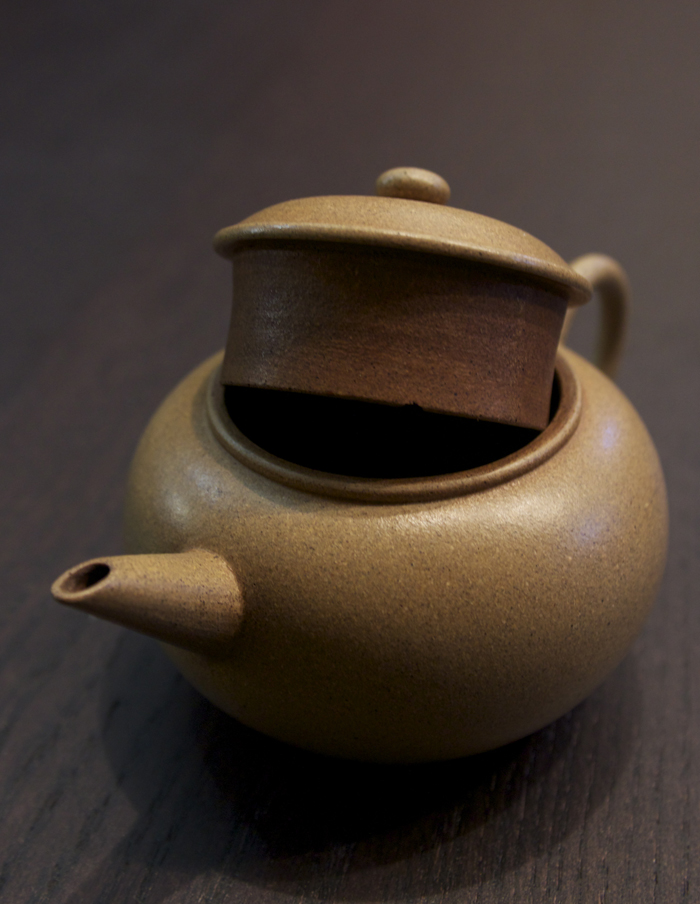
The puerh was a segue into a very lim­ited Yan­cha from Tim’s col­lec­tion. He care­fully demon­strated how to build the pot in three layers.

The desired amount of tea was laid out on the first sheet of paper, and whole leaves were selected and moved to a sec­ond sheet. A hand­ful of whole leaves was crushed to form the bot­tom layer of the pot. Reserved bro­ken pieces formed the next layer, and the rest of the pot was filled with the remain­ing whole leaves.

This was a very exclu­sive tea from a farmer who pro­duces 2 to 4 lbs of this tea a year. It was roasted 8 times, and the taste is very unlike any Yan­cha I have pre­vi­ously encoun­tered. I don’t know whether to attribute this to the skill in roast­ing, or the age of the bushes.

The pot of leaves was left in my care along with a chal­lenge. To brew the tea for 5 min­utes each morn­ing, and to refill with boil­ing water to sit for the rest of the day. Two infu­sions are to be drunk each day for as long as the tea will last.

Depart­ing

Any­one who could stay joined us for din­ner — we rushed to the restau­rant to beat clos­ing time and ordered plates full of “Chi­nese” food — beef and noo­dles, seafood pad thai, a deli­cious egg­plant dish and more. We returned to the stu­dio to clean up and called it a night.

Inter­spersed Events

Before the start of the event, Mike and I ate for lunch at the Bay Leaf and headed to Chi­na­town for some trea­sure hunt­ing. We each bought Yix­ing tea boats and some inex­pen­sive hong ni pots. I found a cast iron trivet
to go with my tetsubin.

We ate ice cream waf­fles from the freezer in a Japan­ese mar­ket before meet­ing up with Tim, who served us large pas­tries from a Hong Kong style shop.


The next morn­ing, I tor­tured Mike by mak­ing him wake up at 6:30 to resume his kung fu cha train­ing. We drank dan cong from a new Chi­na­town pot, and the first of the pre­scribed 5 minute Lao Cong brews. Before we could brew much more, I had to catch the sub­way towards Penn Sta­tion and make my way home.


05
Sep 09

NYC Tea Meetup #1

In search of the elu­sive Tea Pearl, brave friends gath­ered at The Tea Gallery for the first NYC Tea Meetup. Being the inau­gural I decided to doc­u­ment this one in some detail — I expect that I may drop off sooner or later as the jour­nal of record.

Mys­tery For­mosa Oolong

When I arrived Tim had already wres­tled Win­nie out of her seat and had taken over as Tea Mas­ter. In a large pot of Tai­wanese clay, Tim brewed up sev­eral rounds of the unknown tea. He tried to get us to ignore his brew­ing chops by sug­gest­ing that the real tea mas­ter only focuses on lin­ger­ing fla­vors and aroma, not the ini­tial impres­sion of the brew. Nice save!

This was a nice tea, what­ever its source. Thanks to Tim for pro­vid­ing it. We returned to this tea sev­eral times.

100 Year Tree

Win­nie regained her chair to brew this Yan­cha in her own style. Roast was appar­ent but plenty of other fla­vors and a great mouth feel came along to the party. Brew #3 was knocked out of the park, but the tea dropped off quickly after­wards. The aroma of the tea was very impres­sive, chang­ing from brew to brew but remain­ing vivid. For me this tea had a lot of “downer” qi. Dae agrees. I won­der what this tea would do if pushed hard.

2008 Bing Dao — Ice Island

Michael returned home and took over brew­ing. Tim returned after fetch­ing his friend Tony from Hong Kong — a friend redis­cov­ered in NYC after 25 years. Best of all, Tony loves tea and was glad to join us.

A vin­tage gai­wan was soon stuffed with wet, rinsed leaves. We drank this for sev­eral rounds in Michael’s sig­na­tures knock­out style before the leaf was fully open. 

Then, he started to com­bine two batches, to leave some in his new Yixing. 

Our orga­niz­ers Mike and Katy fur­nished us with a fine selec­tion of snacks to put off the munchies from Michael’s pow­er­ful brews. Tim was too tough to par­take in any snacks. The “bo’lay” was not too strong for Tony. He was well seasoned!

Japan­ese Puerh


Tim and I have been talk­ing about this tea ever since Win­nie men­tioned it a few weeks ago. Now she is attempt­ing to hide it from the tea drunks. The shy tea even­tu­ally reap­pears as a nightcap.

Dry leaf smells like black licorice cer­tainly, but also some­thing reminds me of the Long Jing Hong Cha exper­i­ment. Adrian thought that tea was more of a hei cha than a hong cha (fer­mented vs oxi­dized), and that is cer­tainly the case here.

Wet leaves had a very intense aroma, Tim placed it as d’dok cha, a Korean puerh.

Taste was smooth and light, hard to pick much out. This could be due to the small quan­tity of leaves used, but more likely because of the ear­lier abuse from Michael’s 15 minute Bing Dao brew — Time to quit for the evening.


03
Sep 09

On Finishing

We’ve all been told not to waste things. Yes­ter­day I started a ses­sion of a fine 80s puerh that prob­a­bly lasted at least 7 pots — I am not much of a counter. I started back up this morn­ing and it was clear that I would not make a dent in the tea before I had to leave for work.

I decided to trans­fer the leaf into a large, pre­heated yix­ing and brew until my Ther­mos was full. This isn’t the best way to enjoy vin­tage tea, but when I return back home and clean out the spent leaves, I won’t feel like they had gone half used.


16
Aug 09

Chaozhou Yiwu Puerh Cha

Chaozhou Yiwu Puerh Cha from Bran­don on Vimeo.

I just learned this very tra­di­tional method to brew puerh from China. This is the first basis of kung fu cha.
Please be sure to use a very fresh, high qual­ity tea, like a 2009 Yiwu cake.

Update: Please read http://www.teachat.com/viewtopic.php?f=20&t=10608 before attempting.


18
Jul 09

Split Fire Pottery

I met Bill of Split Fire Pot­tery via the TeaChat TeaWareArti­sans forum. I con­tacted him about mak­ing a cus­tom piece, and he trans­lated my ideas into clay with fidelity. We had a lot of fun chat­ting in between fir­ings. If you see any­thing on his store you fancy, or even have imag­ined a spe­cial piece in stoneware, please drop him a “line”. You might be inter­ested in my video review.

Split Fire Pot­tery from Bran­don on Vimeo.


21
Feb 09

Da Wu Ye, Dan Cong

So, I am play­ing around with a cam­era and Adobe Pre­miere Ele­ments. The ban­ner is a pain, but I will pur­chase the soft­ware very soon. I will pos­si­bly post a new ver­sion, but I am pretty impressed with how eas­ily you can pro­duce a video with just a few hours of play­ing around.

Edit: now hosted by flickr


08
Feb 09

Break Me Off A Piece (1997 Shui Xian)

Today is warm, and I sit out­side drink­ing tea from the fan­tas­tic Tea Gallery. It is very nice to finally have some nat­ural light for pho­tograph­ing. I don’t have much to say about this tea that Brent hasn’t already writ­ten.

I am using more leaf than him (half a stick in a tiny 60cc gai­wan), so the mineral-y-ness is very intense. This sub­sides after 4 or 5 intense steepings. 

If candy bars tasted this good, I would be a very fat man. Luck­ily, I have this tea instead.

For some rea­son this photo reminds me of the work of Alex. May he soon cap­ture some light of his own and return to the fray. 

I have con­ducted a few exper­i­ments today that may war­rant a sep­a­rate post at a later date. Tast­ing the same steep­ing from both celadon and porce­lain have pro­duced slightly unwel­come results. Celadon has rounded out (or per­haps just stolen from) the tea sev­eral char­ac­ter­is­tics like the intense min­eral pro­file men­tioned above.

This is espe­cially appar­ent in the new cups in my last post, but also in a celadon fair­cup. Per­haps the cups need to sea­son a bit? Am using porce­lain and glass for the rest of the day.


07
Feb 09

Menghai 1996 7532 “Green in Orange”

As this tea is some­thing like a long lost friend, I was very excited to see this tea offered at Nadacha. A few of you may remem­ber back a long time ago, finally over the shock of crappy shu, I set out to give this puerh stuff a fair shake. Jason offered some sage advise on what sam­ples to nab first. 

At the time, Hou De was offer­ing a sam­ple of the 1996 7532 Orange in Orange*, which con­se­quently became the first sheng puerh that I truly enjoyed.

I was indeed sur­prised to see it return, and even though the price has increased in the Asian mar­ket, per­haps this will serve once again as a fan­tas­tic intro­duc­tion to puerh for another tea crazed Westerner.

The dry leaf is per­fectly browned by the last 12 years. Stor­age is unknown but the leaf is lovely with very few white specks.

This tea is thick! Creamy, a lit­tle sweet. I don’t find cam­phor or a hint of spice that is often enjoyed in such teas, but I am very bad at nam­ing fla­vors. This teas energy is slightly warm­ing, calm­ing, but not very strong over all.


The film seen on top of the tea here is a tes­ta­ment to its rich­ness. There appears to be an arti­cle on this in Art of Tea 5, which I have not fin­ished just yet. I am not sure I even care for an expla­na­tion, drink­ing the tea itself is just fine with me.

If you are new to puerh, I hope you will pick up 30g of this tea. It should give you many happy sessions.

* Orange in Orange earned its nick­name from the orange nefei installed neatly into an orange wrap­per. Unfor­tu­nately part way through the pro­duc­tion, the fac­tory ran out of orange nefei and Green in Orange was born. The tea blend is identical.


18
Jan 09

An Experiment: Shooting In RAW

As an ama­teur pho­tog­ra­pher with no real train­ing, I rely much too heav­ily on my camera’s LCD screen for quick review. When light­ing is poor, I will adjust aper­ture, shut­ter, or ISO to try and make the image look fully exposed on the LCD. Often, upon upload­ing the images to my PC, I am dis­ap­pointed to find that they are much darker than what I reviewed on the cam­era. Brent sug­gested that I shoot in RAW for­mat to allow for loss­less edit­ing of the image later on. Here is an exam­ple of cor­rect­ing expo­sure with­out a notice­able degra­da­tion of the image you would see in JPEG.

Underexposed original Corrected image

The dif­fer­ence is more obvi­ous in the full size, so click through to the Flickr page. I threw in a Mole­sk­ine note­book for a cheap laugh from the guys over at Rho­dia Drive, I will read­ily admit that the paper of this note­book is infe­rior. It is still pretty sweet, though.


09
Jan 09

Acquisition

1980’s Chang Ning Zhuan­cha
1980’s CNNP Cooked Brick
1993 Meng­hai 7542
1996 Meng­hai 8582
1997 Meng­hai 7572
Tra­di­tional Dong Ding
Ali Shan, Jade
Ali Shan, 30% Roast
Shan­lis­han
Baozhong