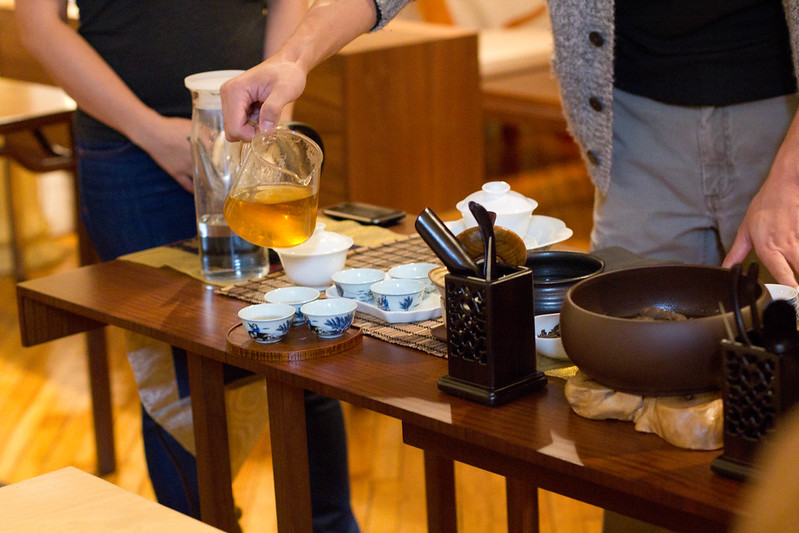
For those of us who keep coming back to tea year after year, there is a much greater reward than a hot beverage or a familiar taste. More than the uplifting properties of caffeine or the calming effects of l-theanine alone.
You could substitute most of these qualities in a dozen other ways. So why would someone focus as heavily on tea — and tea alone — as those reading here are known to do?
For those most passionate about tea, our ideal for each and every cup is to stimulate the mind along with our senses. This factors heavily into how we judge tea. Someone just beginning their tea journey may be surprised to hear that some seasoned tea drinkers rank initial taste as one of the least important forms of sensory evaluation.
Before diving into what makes one tea good and another tea great, we should very briefly introduce some ways that tea can excite our other senses. For some people, it will take time to develop the sensitivity to describe these sensations, but it helps to know what areas to be mindful of.
After initial taste and aroma, the first thing tea drinkers are likely to focus on is known in Chinese as 回甘 [huí gān]. In English, a near literal translation is “Returning Sweetness,” but we can think of this loosely as aftertaste. You can experience this clearly in most good teas, and probably already have. In the best teas, though, the taste can go on for hours.
The next place to focus is feeling in the throat. Tea here can be cooling or warming, rough or wet. Often drinking good tea will give you the sensation of a ball in your throat. It is good to consider how far down the tea goes — in other words, where the sensation is no longer apparent. If the tea slips down without any notice, it is just a drink. Many good teas will stop somewhere in the middle of your throat. If it gives a pleasant feeling all the way down to your core, it is truly something special.
A good place to first look for throat feel is Wuyi Yancha. This tea is often said to be unique for its prominent 岩韻 [yán yùn], or “Rock Feel,” evident in the throat.
Possibly the most nebulous of tea’s qualities are ascribed to 茶氣 [chá qì] — a tea’s “energy.” Most readers will probably be familiar with at least some of the wide ranging effects it is attributed with. Practically any physical or mental stimulus outside of the mouth, nose, and throat falls into the realm of cha qi.
Some more obvious manifestations of cha qi are a heating or cooling of the extremities (eg, sweaty palms when drinking a ‘warming’ tea like aged puerh or heavily roasted oolong), a flushing of the face, or a measurable change in mood. In a small group, tea can either lead to deep conversation, giddy laughter, or contemplative silence.
I find that the stress of the day usually accumulates in my shoulder, and I greatly appreciate tea’s ability to trigger relaxation in tense muscles.
In teas with the most powerful cha qi, a person can feel “blissed out” and start to notice a feeling of pressure around the head. Pressure on the top of head, brow, temples, or a feeling of tightness in the jaw are all feelings to look for, and are all indicators of strong cha qi.
There are of course many other places you can find cha qi — a favorite description of mine comes from Matt, who related that the tea we were sharing felt “like a warm hug around the belly.”
If any of the descriptions here are unfamiliar to you, that is perfectly normal. Just enjoy the tea and remain mindful. Drinking with others is a good way to find out what others are experiencing, and see how you can relate.
In the next post, we will put the language of experiencing tea to work, to help explain the difference between one good — and one great — tea.
I have a hard time totally grasping yan yun, and I think it’s hard to translate (many tea sellers use a very literal translation like ‘charm’ or ‘rhyme’.) One friend suggested that ‘echo’ is probably fairly close. I guess different folks have different concepts of what yan yun is, but I’ve always understood it to be describing a taste (and more specifically, a lingering aftertaste), rather than a feeling in the mouth.
Even after drinking yancha frequently, I’m hard-pressed to say for sure that I can identify yan yun when I experience it. I have heard it described by one friend as like the literal taste of rocks in your mouth (say, driveway gravel, or granite). There is a taste (slightly different from that) which I have noticed in many of the yancha that I’ve drank, that I consider “yan yun” for me, but I don’t know whether that’s really it.
Really great article. I have about the same feeling with description off tea in body.
Amicalement
Nicolas
Epic post Brandon. As I progress on my tea journey the sensations you describe here are beginning to manifest themselves in my tea drinking rituals. Thanks for sharing and I look forward to the follow up posts.
Great tea enlightenment B! Cant wait for the next post ~ T
Cha Qi? Oh! I thought everyone was talking about Chachi?
http://bit.ly/lIpa81
This was a great post. I am just beginning my journey through the world of tea and this was good for me. I have been drinking tea for many years but never paid much attention to it. Now I have a desire to know more. I look forward to sitting down to your next post with my favorite tea.
great post, cha qi for me did not become such a strong focus until i started drinking higher quality teas. I can really relate to that “blissed out” feeling after the Tea Institute had a visit from TeaParker and he brewed us some 1976 shu pu. there were about 8 of us in the room and we were all dead silent with huge smiles on our faces just bugging out after the first sip. Its interesting that describing the feeling from that tea would definitely be difficult to do to someone who has never tried it, but anyone who has would immediately understand.
Pingback: Oakland Art Murmur 7.3.11 | rootdtea
Your posts are very interesting. I have reported a link to your blog on my tea ceremony blog(italian and english).
(if you’re interested the link is http://cerimoniadelte.blogspot.com/ )
If you want you can return the favor.
Thank’s. Letizia
Thank you for this very insightful post.
I’ve decided to feature this post as part of my weekly link-up. Just so you know
You can find the post here:
http://the-teaist.blogspot.nl/2012/12/tea-talk-link-up-6.html
All the best!
Goodness, thank you, Teaist!